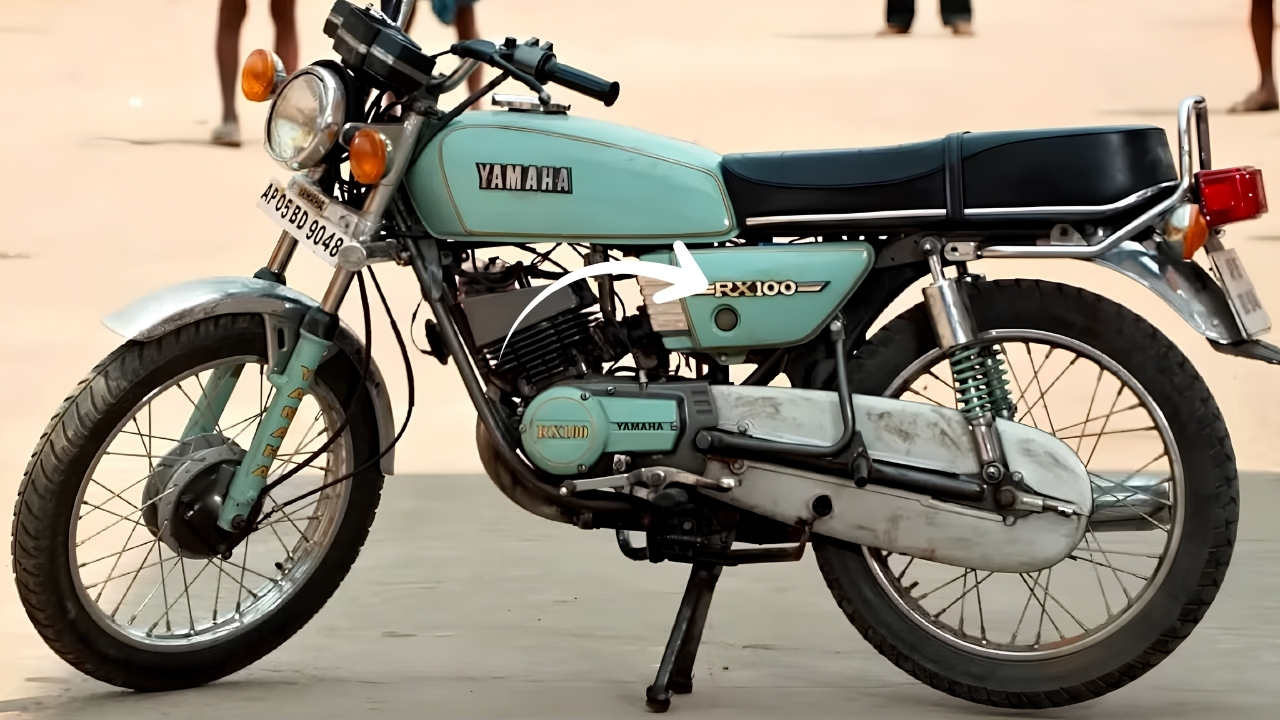
Yamaha RX100 : The Yamaha RX100 continues to command extraordinary attention in India decades after production ended. While talk of a modern comeback has intensified, Yamaha has not officially announced a new RX100 launch, technical specifications, launch date, or price.
A motorcycle that became a cultural icon
Few motorcycles have created the emotional connection that the Yamaha RX100 built with Indian riders. Introduced during the mid-1980s, the lightweight two-stroke motorcycle earned fame for its quick acceleration, compact proportions, simple mechanical layout and unmistakable exhaust note.
It was not the most practical bike in every situation, but it offered something commuters of that era rarely received: excitement.
The original RX100 used a 98cc, air-cooled, single-cylinder two-stroke engine. Its low weight and lively power delivery made it feel quicker and more responsive than many motorcycles around it.
For a generation of young riders, the bike represented freedom, speed and individuality. Even today, a well-maintained original RX100 can draw crowds at local rides, restoration meets and motorcycle gatherings.
Its popularity also grew because it was easy to personalise. Owners often changed handlebars, exhausts, paint schemes, seats and wheels.
Some restorations remain close to factory condition, while others reflect the style of their owners. That flexibility helped turn the RX100 from a machine into a long-lasting part of motorcycle culture.
Why RX100 comeback rumours continue
The RX100 name has never really disappeared from public conversation. Every few months, social-media posts, videos and reports claim that Yamaha is preparing a relaunch.
Some reports suggest a retro-inspired machine, while others speculate about engines ranging from 125cc to more than 200cc. However, such claims should be treated carefully unless Yamaha itself announces the motorcycle.
Yamaha has acknowledged the strong public affection for the RX brand and the company’s interest in recreating that kind of emotional connection.
But recreating the original RX100 in its old form is not realistic. The classic two-stroke engine was central to the bike’s character, yet modern emission standards make a straightforward revival impossible.
The original engine’s sound, smell and sharp power delivery came from technology that would struggle to meet present-day environmental regulations.
That is why any future RX-inspired motorcycle would almost certainly be very different underneath its retro styling. A modern four-stroke engine, fuel injection, updated brakes, improved lighting and contemporary safety equipment would be expected if Yamaha chooses to use the badge again. The challenge will be preserving the personality of the old motorcycle without merely relying on nostalgia.
Recent reporting has suggested Yamaha is pursuing a stronger premium and performance-oriented strategy in India, seeking to reconnect with the emotional appeal it once established through motorcycles such as the RX100.
That direction has encouraged fresh speculation, but it does not amount to confirmation of an RX100 production model.
The problem with a direct revival
A genuine RX100 revival would be difficult for several reasons. First, the original motorcycle was built around a small two-stroke engine, and current emissions rules are far stricter than those in place during the RX100’s production years. A modern motorcycle has to balance performance with clean emissions, durability, noise limits and fuel efficiency.
Second, customer expectations have changed. Riders now expect stronger braking systems, better tyres, reliable electrical components, modern suspension and safer chassis design.
Many buyers also look for USB charging, digital displays, LED lighting and connectivity features. Adding these elements can make a motorcycle heavier, more expensive and less mechanically simple than the original.
Third, the RX100 name brings enormous expectations. Yamaha would not simply be launching another commuter motorcycle; it would be bringing back one of the country’s most celebrated two-wheelers. If the new model feels too slow, too heavy, too expensive or too far removed from the original, enthusiasts may reject it.
On the other hand, if Yamaha focuses only on retro appearance without offering real performance, the bike could lose the very spirit that made the RX100 special.
This is why industry discussions often point to a larger-capacity, modern engine rather than an attempt to recreate the old 98cc format.
A new machine may carry RX-inspired styling and sporty intent, but it may not be an exact replacement for the legendary motorcycle.
What a modern RX could look like
If Yamaha decides to revive the RX identity, the best approach would likely be a lightweight retro roadster with modern engineering.
The design could include a round headlamp, slim fuel tank, flat seat, simple side panels and clean graphics inspired by the classic bike. However, the frame, engine, brakes and electronics would need to be thoroughly modern.
A four-stroke engine with strong low- and mid-range response would be more important than headline power figures. The original RX100 was loved because it felt alert in everyday riding, not because it was built for top-speed records.
A future model would need to deliver that same sense of urgency when pulling away from traffic lights or moving through city streets.
Yamaha would also need to manage the exhaust character carefully. The old RX100’s sound was one of its greatest attractions, but a new motorcycle cannot replicate it exactly.
Instead, Yamaha could aim for a distinctive and sporty exhaust note that feels authentic without violating noise and emissions norms.
For many enthusiasts, the ideal modern RX would not be a copy. It would be a motorcycle that captures the old formula: low weight, simple styling, responsive performance and a strong emotional appeal.
The real status of the Yamaha RX100
At present, the RX100 story is driven mainly by nostalgia and speculation. Reports that claim an exact two-stroke relaunch, confirmed release date, official mileage figure or final engine capacity should be viewed with caution unless they come directly from Yamaha.
Some recent articles explicitly note that the original two-stroke motorcycle cannot return in a BS6-compliant form, while Yamaha’s possible future use of the RX badge remains a separate question.
Also Read this – 2026 Mitsubishi Triton Ultimate features at low budget cost, roaring on USA roads
For now, the original RX100 remains the true legend. Its value lies not only in its performance but also in the memories it carries: early-morning rides, workshop tuning sessions, college commutes and the thrill of hearing that familiar two-stroke engine come alive.
A new Yamaha carrying the RX name could become an exciting chapter in India’s motorcycle market. But until Yamaha presents a production motorcycle officially, the RX100 comeback remains a possibility rather than a confirmed reality.